A Meteor Fell from the Sky and I Couldn't Find the Crowd
(Last week's Broadcast was about a titanium card that survives because the network can't carry the gesture of producing it. This week, a much louder object, and a different thing the network turned out not to carry.)
Puddles on the couch on a cozy, drizzly Saturday afternoon, we were half-watching something on TV neither of us will remember. I was in comfy weekend clothes, wrapped in my blanket, like a soft cocoon. Because of course it is still sometimes chilly in Boston for some reason.
It was the good kind of lazy.
Then the Boom.
Not a thud. A real boom, the kind you feel pulse along the floorboards, resonating in your chest a heartbeat before you decide what to be scared of.
Thunder? A transformer? Gas line? Something... worse? All the things you do not say out loud with someone you love in the room.
We looked at each other and neither of us had a word for it other than maybe, "Confused."
So I did what I always do, which is reach for my phone and ask several hundred thousand strangers whether they felt it too.
Signal: The town square wasn't where I left it
What I was doing, along with much of eastern Massachusetts at 2:11 that afternoon, is what crisis researchers, in their charmless way, call "collective real-time sensemaking." Something sudden and ambiguous happens, and a crowd metabolizes it together. Who else heard it, and how far did it reach? Strangers become a single nervous system for an hour, passing signals up the chain until the thing has a name.
I have immersed myself in this before. I wrote about it in 2020, in an essay about living through what I called lower-resolution channels, the months when "the resolution of the world gets lossy." Back then a sudden event arrived as an "initial flash of primary sources followed by an immediate and devastating shockwave" of retweets. One feed, one place everyone already stood. You opened Twitter and the answer assembled itself in front of you, narrated by witnesses and experts wading in the same river. Alfred Hermida called it ambient journalism, an always-on awareness stream you could glance at to keep a running mental model of the world around you.
That was the baseline. So on Saturday I reached for the river, and it was not where I left it.
The boom, for the record, turned out to be a meteor. A rock about five feet across came in at 42,000 miles an hour and broke apart over the coast with the force of 230 tons of TNT, dropping fragments into Cape Cod Bay.
Apparently this happens all the time. Like... a disturbingly ordinary event.
Every day, Earth is bombarded with more than 100 tons of dust and sand-sized particles.
About once a year, an automobile-sized asteroid hits Earth’s atmosphere, creates an impressive fireball, and burns up before reaching the surface.
Every 2,000 years or so, a meteoroid the size of a football field hits Earth and causes significant damage to the area.
Sleep well.
But I did not know any of this a the time of the May 30th Boom.
When the single feed shatters, where does "what just happened" actually get figured out now?
Probe: I went looking for the crowd and found a hundred small ones
I did not build this experiment, I watched it. For an hour I followed a region trying to solve a mystery in real time, and paid attention to where the answer actually formed.
The old machinery still worked, but it did not feel nimble. I listened to live police scanners responding to a flood of 911 calls from people in the Boston area. Even the first responders were struggling to figure out what was happening. But it confirmed that we weren't the only ones to have heard it. On X, the live thread was mostly meteorologists and local-news accounts doing careful public reasoning: no earthquake on the USGS feed, but a flash on weather radar where there was no thunder, which points at a meteor instead of a transformer. NASA posted an update… 2 days later.
Useful and authoritative, and oddly like tuning into a professional wire rather than standing in a crowd in the middle of something. (I haven't engaged with Twitter/X in a very long while, so it felt unfamiliar to me, regardless). Over on Bluesky, a smaller cluster of weather people and academics reached the same answer, one of them narrating it live: boom in Cambridge, reports coming in on Reddit, here is the satellite image. She was not in the town square. She was building one out of pieces, a little Reddit and a little satellite, the truth stitched together, by hand.
Then somebody did exactly that, with slightly better tooling. Within the hour, a Somerville Redditor posted three words, "threw together a map," and a link to a shared Google map. Drop a pin where you heard the boom. The comments stopped being comments and became data: North Cambridge, Lowell, Providence, Newton, Davis Square, Reading. Someone in r/boston pulled NOAA's GOES-19 satellite lightning data, found the flash, and turned a raw government feed into a plain-language explainer before a single newsroom had a headline up. NASA's own event page for the fall was the same instinct in a lab coat, just slower.

A neighbor's Google map, an hour after the boom. (via r/Somerville)
The fastest, most useful response to "what just happened" was not a post. It was a build. The quickest people in the crowd reached not for the megaphone but for the toolbox.
The nimblest civic response to a sudden event is no longer a post. It is an instrument.
In 2020, the high-status move was to be first to publish: first to the clip or the quote-tweet that framed the moment for everyone. There is a new rung above it now: first to instrument. First to stand up the map, first to turn a raw feed into something the rest of us can read.
This works because building got cheap and fast. The thing that used to need a mapping team and a week now needs a sentence and a coffee. Cursor writes the code. Felt turns plain English into a map. When the town square fragmented, the crowd did not go quiet, it went handmade.
The trade is real in both directions. We gained speed and resolution... a crowd that reached "meteor" off an absent earthquake reading while the institutions were still drafting. But we lost the shared "we," the single place where one answer becomes everyone's answer at the same moment. Trust moved with it, away from "I saw it on Twitter" and toward whether a post shows its work, the satellite frame next to the dog that did not bark. And a lot of the real sensemaking went dark, into Nextdoor, group chats, the neighborhood Discord, the family text thread, rooms that matter enormously and archive nothing.
Signals Worth Tracking
The instrument that became infrastructure

What 'first to instrument' looks like once it grows up. (via Watch Duty)
The Saturday map was a toy. Watch Duty is what the same instinct looks like at scale. A nonprofit started in 2021 by volunteers listening to fire-scanner radio now runs 18 automated radio devices and 150-odd active and retired first responders, pushing confirmed wildfire and evacuation alerts faster than most official channels. It went from 1.9 million users to 7.2 million in a year and became a lifeline during the L.A. fires. When does a homemade instrument quietly become the system of record everyone trusts?
The dashboards vanish faster than the posts
The strange archival problem of 2026 is that the tooling layer is more fragile than the talking layer. The Saturday map, the satellite screenshots, the throwaway dashboards: most of them will be gone or unfindable in a month, while the jokes about the boom live forever. We are building a real-time civic memory with no archive. The durable counter-example is something like Development Seed's open fire-event explorer, built to last on public satellite data. Who, if anyone, preserves the instruments we build to understand a moment?
The 48-hour moving model
Watch the official numbers shift in public. The first estimates put the rock at three feet and 300 tons of TNT; two days later NASA had it at five feet, 5.6 metric tons, and 230 tons of TNT. Avi Loeb weighed in with his read of the energy. The event never moved, but the shared model did, out loud, over 48 hours. How do you show a fact that is still settling, without either overclaiming or shrugging?
Filed under: the sublime, documented by someone in a muffin costume
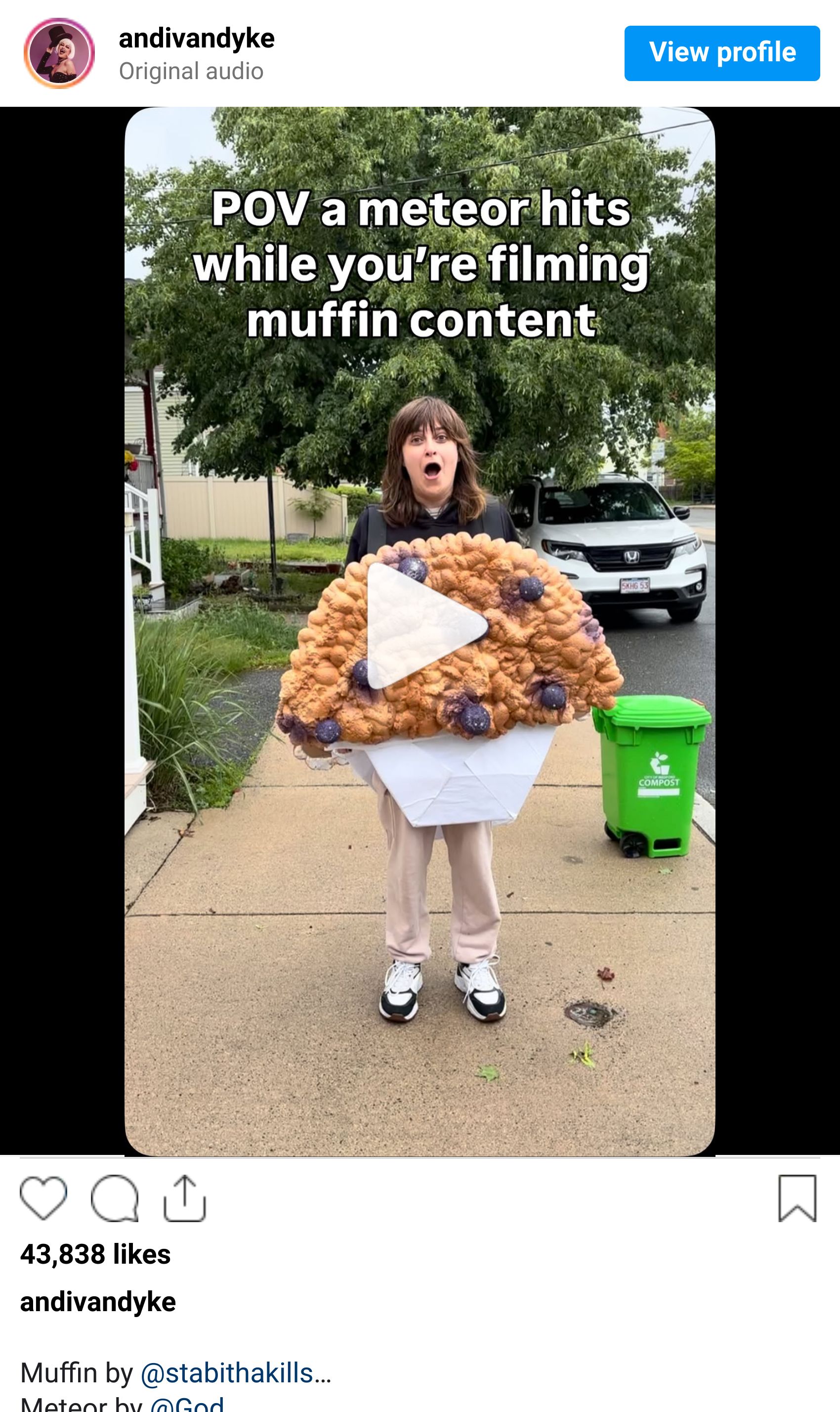
My favorite artifact of the weekend is the collection of videos where the meteor is incidental: doorbell cams, a dashcam near 495, and one person who caught the boom of the year while fully dressed as a blueberry muffin. Someday I want to write about how the most powerful events now reach us as the blurry background of someone else's ordinary Saturday. Ring cameras as the 24/7 news factory. Not today. But I am keeping the muffin.
Back on the couch with L, phone finally face-down. A week ago I wrote that the card survives where the network cannot carry the gesture. Saturday taught me the sequel: the instrument survives where the feed cannot carry the we. We lost the town square, and in its place we all quietly learned to build, which might be the only kind of "we" that scales now.
So the next time something detonates into your awareness, what will you build?
/ David
On repeat: Skyfall, Adele, 2012. 🎶 "Feel the earth move, and then / hear my heart burst again…" 🎶 (For once, the sky actually fell. Cape Cod Bay caught it.)
Reading: Kate Starbird on rumors as collective sensemaking, the cleanest current frame for treating a confused crowd as a signal-processing system instead of a mob.
Building: something pointed in a new direction. The deeper I get into "first to instrument," the more I think the next things I build won't be for me, they'll be for other people. More on that soon.